


Online Drivers Ed vs. Defensive Driving: How to Pick the Right Course

Drivers Ed That Fits Your Life
Self-paced, online, and ready when you are. Learn to drive on your own schedule.
Quick answers:
- Getting licensed for the first time? You need drivers ed. Dealing with a ticket, points, or a rising insurance bill? You need defensive driving or traffic school.
- They are not interchangeable. A defensive driving certificate will not get you licensed, and a drivers ed certificate will not clear a citation. Different agencies, different paperwork, different outcomes.
- Approval is state-specific. Confirm which agency regulates your course type and that your provider appears on its list before you pay, because a course the state does not recognize cannot be filed.
Most people searching for a driving course already know they need one. What they do not know is which one. The word "course" gets stretched across at least three products that share a name, share some content, and do completely unrelated things to your record. Pick the wrong one and you have spent an afternoon on something your court, your DMV, or your insurer will not accept.
Here is how to sort it out in one pass.
Start With Why You Need a Course
Everything downstream follows from this. Skip the course catalogs and answer one question first: what are you trying to make happen?
You want a license you have never held
That is drivers ed, and it lives on the licensing side of the house. Your state's licensing agency decides whether you need it, how many hours it runs, and what certificate it produces. Teens almost always need it. Adults need it in fewer states, but the states that do require it enforce it strictly.
You have a ticket, points, or a court order
That is defensive driving or traffic school, and it lives on the enforcement side. Sometimes a court orders it. Sometimes you request it. Either way the certificate goes to a court or a motor vehicle agency, not to a licensing examiner.
You just want a lower insurance bill
Also defensive driving, but through a different door. Many states require insurers to discount premiums for drivers who complete an approved safety course voluntarily, and several run a dedicated mature driver discount program for older drivers. No ticket required. No court involved.
What Drivers Ed Actually Covers
Drivers ed is the prerequisite. It exists to make you legal to drive, and its structure follows whatever your state's graduated licensing rules demand.
Teen drivers ed and the behind-the-wheel piece
Teen programs are the longest of the three course types by a wide margin, often stretching to thirty hours or more of instruction plus a separate log of supervised driving hours. The classroom portion is frequently available online. The behind-the-wheel portion is not, and no state lets a video substitute for actual time at the controls. Parent-taught programs exist in some states and let a parent or guardian supervise the driving hours instead of a paid instructor.
Adult drivers ed and where it is mandatory
This is the piece most adults get wrong, because they assume turning eighteen ends the requirement. It does not, in every state.
Texas requires first-time applicants ages eighteen through twenty-four to complete a six-hour adult course approved by the Texas Department of Licensing and Regulation, which produces an ADE-1317 certificate and, in most cases, satisfies the written knowledge test. Illinois requires an adult drivers ed course for applicants who are eighteen through twenty and have never been licensed. Florida requires every first-time applicant eighteen and older to finish a four-hour Traffic Law and Substance Abuse Education course before applying.
If you are in Texas and unsure what applies to you, the Texas Adult Drivers Ed course page walks through the age brackets, and the breakdown of what eighteen-year-olds need in Texas covers the document side.
The pre-license extras states bolt on
Several states stack a second, short requirement on top of the main course, and missing it stalls you at the counter.
- Texas: the Impact Texas Drivers program, a free distracted-driving video run by the Department of Public Safety. Adults watch the roughly one-hour ITAD version. The completion certificate is only good for ninety days, so timing it against your road test appointment matters. See the DPS Impact Texas Drivers page for the current rules.
- Florida: applicants under eighteen now take a six-hour Driver Education Traffic Safety course instead of the older four-hour course, a change that took effect August 1, 2025. Adults eighteen and older still take the four-hour version. The FLHSMV DETS page lists the exemptions, and our Florida DETS explainer covers who is grandfathered.
Freedom Starts With a Course That Respects Your Time
Self-paced, fully online, state-approved. Your license, your way forward.

Important Seatbelt Facts Every Driver Needs to Know
If you’re not buckling up every time you drive, you’re making a big mistake. Check out these important seatbelt facts every driver needs to know.

5 Mandatory Safety Features Saving Lives (and 3 Extras)
Cars and trucks are safer than they've ever been. These 5 mandatory safety features save lives every day — and these 3 add-ons could change driving forever.

New California Driving Laws: What They Mean for You
Know the new California driving laws that went into effect in 2018.
What Defensive Driving and Traffic School Actually Do
Here is where most of the confusion lives, because three very different outcomes get described with the same casual phrase: "it takes the ticket off your record."
Dismissal, masking, and point reduction are not the same thing
Dismissal means the citation goes away. Texas works this way. You request the course from the court before your answer date, plead no contest or guilty, complete a six-hour approved course, and submit the certificate along with a Type 3A driving record. Do it correctly and no conviction is entered. The requirements are cumulative, and one of them catches people off guard: you need a valid Texas license or permit, or you need to be active-duty military or the spouse or dependent child of someone who is. Unlicensed drivers do not qualify.
Masking means the conviction stands but stops showing on your public record. California works this way. The conviction stays with the court and the DMV for their own purposes, but it is held confidential and no point is assessed. You get one masked conviction per eighteen-month window, and that window is measured violation date to violation date, not from when you took the class. Our California traffic school course page has the eligibility checklist.
Point reduction means the ticket and the points both stay visible, but the state subtracts points from the total it uses to decide whether to suspend you. New York works this way. Its Point and Insurance Reduction Program is a six-hour course that reduces up to four points for the purpose of that calculation and triggers a required ten percent reduction in the base rate of liability and collision premiums for three years. The violations themselves remain on the record for up to four years. The New York DMV PIRP page spells out the distinction, and our New York PIRP course page covers the reporting timeline.
How often you are allowed to use it
Every state caps this, and the caps are not the same shape. Texas allows a dismissal once in the twelve months preceding the offense date. California allows one masked conviction per eighteen months. New York allows point reduction every eighteen months and the insurance discount every thirty-six. Florida allows one election per twelve-month period and, under a change to its statute, up to eight elections in a lifetime, a number a lot of course sites still report incorrectly as five. FLHSMV confirms the current figure.
The voluntary insurance track
You do not need a ticket to take one of these courses. In states with a mandated discount, completing an approved course and handing the certificate to your insurer is enough. In states without a mandate, many carriers still offer something, but you should call and confirm before you enroll rather than after. Our defensive driving course hub lists what is available where.
Why the Same Course Has Half a Dozen Different Names
There is no national naming convention, which is why searching for the exact phrase your court used often returns nothing useful. The underlying product is largely the same. The label is not.
A quick translation guide
- Texas: driving safety course, or DSC. "Defensive driving" is the everyday term for the same thing.
- California: traffic violator school, or TVS.
- Florida: Basic Driver Improvement, or BDI, running four hours.
- New York: Point and Insurance Reduction Program, or PIRP, also called an accident prevention course.
- Indiana: a driver safety program run through the Bureau of Motor Vehicles, which can produce a safe driver credit. See our Indiana defensive driving course page.
- Elsewhere: driver improvement, traffic survival school, accident prevention, or simply traffic school.
When a court hands you paperwork, use the exact term printed on it when you search. That is the term the court's system will recognize on the back end.
How to Confirm a Course Is Approved Before You Pay
This is the single highest-value thing you can do in the fifteen minutes before you enroll, and almost nobody does it.
Find the agency that owns approval in your state
It is rarely the agency people assume. In Texas, driver education and driving safety courses are regulated by the Texas Department of Licensing and Regulation, not by the Department of Public Safety, even though DPS handles the license itself. In California, traffic violator schools are licensed by the DMV and searchable through its occupational license lookup. In New York it is the DMV. In Florida it is the Department of Highway Safety and Motor Vehicles. Approval for one course type does not carry over to another.
Check the provider number, not the marketing copy
Approved providers carry a state-issued school or provider number. Look for it on the course page, then confirm it against the agency's own list rather than taking the site's word for it. A page that says "state approved" without naming an agency or a number is not telling you anything you can verify.
Confirm how completion gets reported
Some states require the provider to report electronically. Some require you to physically deliver a certificate to a clerk by a deadline. Some require both, plus a certified driving record. Knowing which applies to you before you start prevents the most common failure, which is finishing the course and then missing the filing step. Our overview of DMV-approved traffic school covers how reporting differs.
Online or Classroom
For most course types in most states, this is no longer a real debate. Online is approved, self-paced, and produces the identical certificate.
Where online is the default
Defensive driving, traffic school, adult drivers ed, and the classroom portion of teen drivers ed are all commonly available online with full state approval. Our roundup of which states allow online defensive driving breaks it down state by state.
Where a seat or a car is still required
Behind-the-wheel hours are the obvious exception. A handful of courts also specify classroom attendance in their orders, usually for serious violations, and a court order overrides your preference. Read the order.
How Long Each Course Takes, and When to Start
Length is set by statute, not by the provider, so a course advertised as shorter than the legal minimum is a red flag rather than a bargain.
Typical lengths
- Defensive driving and traffic school: four to eight hours depending on the state, with six hours common and Florida's basic course at four.
- Adult drivers ed: around six hours in the states that require it.
- Teen drivers ed classroom: thirty hours or more, plus separate supervised driving hours.
The deadlines that actually bite
Course length is rarely the constraint. Deadlines are. Requesting a Texas dismissal after your answer date has passed forfeits the option entirely. Electing Florida traffic school later than thirty days after the citation forfeits it too. Court-set completion windows are frequently ninety days but vary by county. Find the deadline first, then work backward.
One change worth knowing about in Texas
Under Senate Bill 1366, every Texas driver education and driving safety course completed on or after September 1, 2026 must include instruction on construction and maintenance work zones. TDLR has directed providers to update their curriculum. This does not change who needs a course or how long it runs, but the content you sit through will be slightly different depending on which side of that date you finish. TDLR is publishing implementation updates.
What You Should Expect to Spend
Course pricing is not the interesting variable here, but it helps to know the shape of it.
What drives the range
Defensive driving and traffic school sit at the low end, generally under a hundred dollars, and several states set a statutory floor so nothing legitimate goes much below it. Adult drivers ed is comparable. Teen programs cost more because they run longer and often include instructor time in a car. Court fees, election fees, and certified driving record fees are separate from the course itself and are paid to the court or the state, not to the provider, so budget for both.
Pick Your Course in Under a Minute
If you skipped everything above, this is the whole article.
Three questions
- Do you already have a license? No, and you have never had one: you need drivers ed. Check whether your state requires it for your age before you buy anything.
- Are you responding to a citation? If yes, contact the court that issued it before you enroll. In most states the court has to approve the option first, and taking the course early can waste the attempt.
- Are you doing this voluntarily for insurance? Call your carrier, confirm the discount exists and what course qualifies, then enroll in an approved course and send them the certificate.
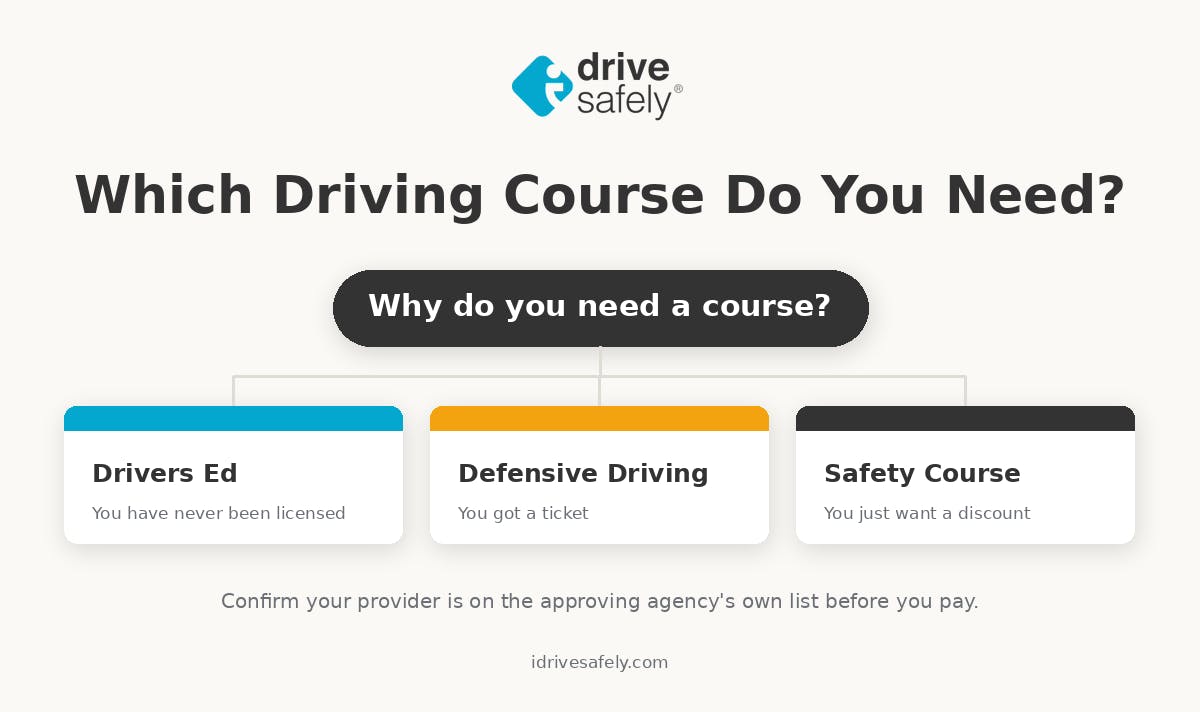
Match the course to the outcome, verify approval with the agency that owns it, and calendar the deadline. That is the whole decision. Ready to start? Browse the Texas defensive driving course, the Florida drivers ed course, or the full course lineup by state.
Looking for more driving resources?
Enter your email for deals, study materials, car maintenance tips, insurance savings, and more.