


New York Driver's License Points: How They Work
Four Points Off Your Driving Record.
Not a dismissal, not a do-over. Just four fewer points standing between you and a suspension
Quick Answer:
- Points are added to your record only after a conviction, but they are dated to the day of the violation, not the day you were convicted.
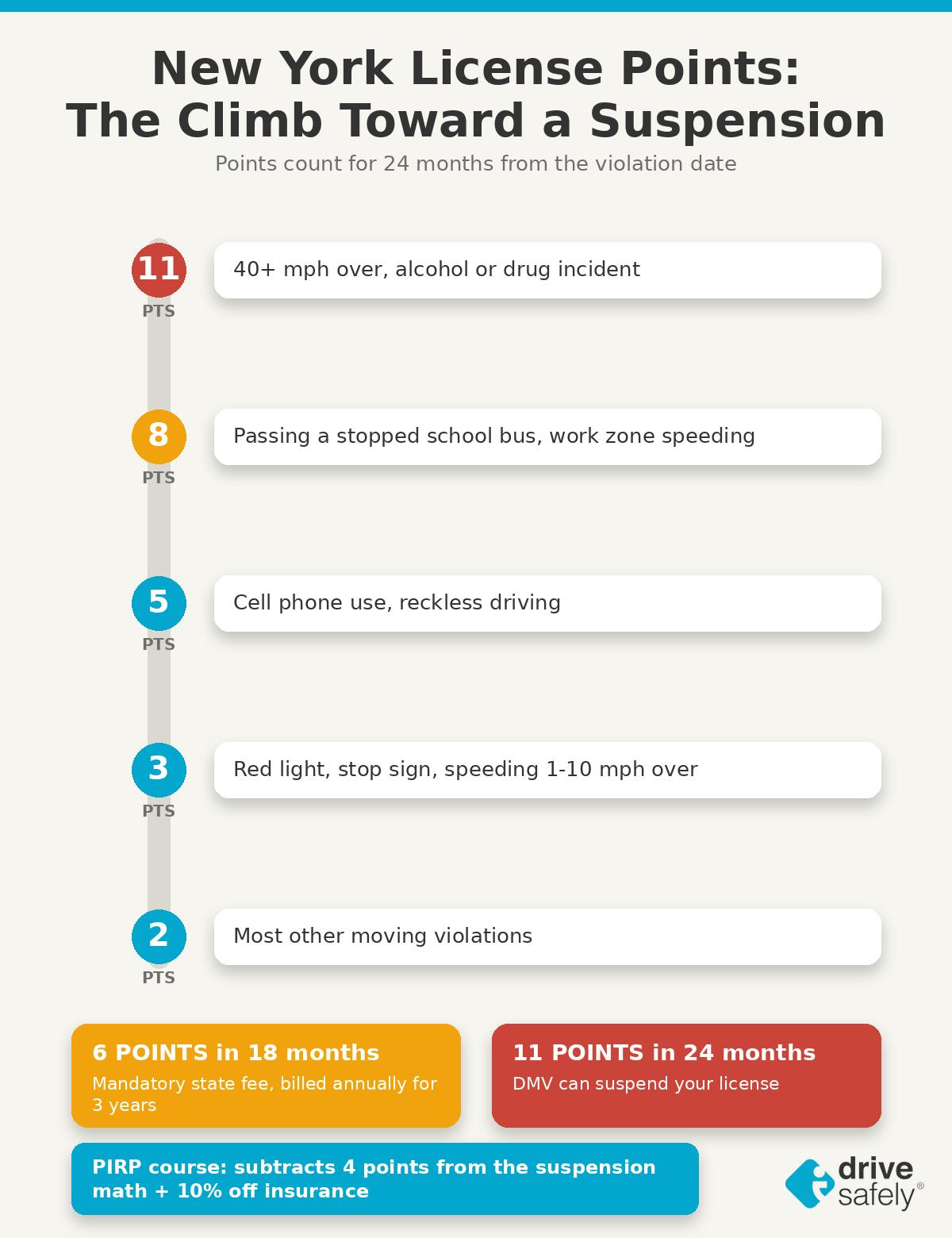
- If you reach 11 points within 24 months, the New York DMV can move to suspend your license. A separate fee kicks in at just 6 points within 18 months.
- A state-approved Point and Insurance Reduction Program (PIRP) course subtracts up to 4 points from your suspension calculation and cuts your insurance base rate by 10 percent.
New York State uses the Driver Violation Point System to identify and take action against high-risk drivers. Every moving violation carries a point value, and once your total climbs high enough, the consequences stack quickly: a mandatory state fee, higher insurance premiums, and possible suspension. The New York State Department of Motor Vehicles (DMV) overhauled the system effective February 16, 2026, raising point values for several violations and extending how long points count against you, so much of what drivers remember about the old rules is now out of date.
How Does the New York Point System Work?
The mechanics matter more than most drivers realize, because two different clocks are running at the same time.
When Points Hit Your Record
You must be convicted of a traffic violation before points appear on your driving record. Pleading guilty by mail counts as a conviction. Once convicted, the points are backdated to the day the violation occurred. That detail catches people off guard: fighting a ticket for months does not push the points forward in time.
How Long Points Count Against You
Points from violations within the last 24 months are added together to calculate your total for suspension purposes, according to the New York DMV. Once a violation is more than 24 months old, its points stop counting toward that total, but the conviction itself stays visible on your record for up to 4 years, and alcohol or drug convictions remain for a decade or longer. Your insurance company can see all of it.
How Many Points Is Each Violation in New York?
Not all tickets are created equal. Speeding is the fastest way to wreck your total, and a single aggressive speeding conviction can put you in suspension territory on its own.
Speeding Points by Speed
- 1 to 10 mph over the limit: 3 points
- 11 to 20 mph over: 4 points
- 21 to 30 mph over: 6 points
- 31 to 40 mph over: 8 points
- More than 40 mph over: 11 points, which is instant suspension territory
- Speeding in a work zone: 8 points
Points for Other Common Violations
- Alcohol or drug-related driving incident: 11 points
- Passing a stopped school bus: 8 points
- Cell phone or portable electronic device use while driving: 5 points
- Reckless driving: 5 points
- Following too closely (tailgating): 4 points
- Running a red light, stop sign, or yield sign violation: 3 points
- Improper passing or unsafe lane change: 3 points
- Most other moving violations: 2 points
Several of these values went up in the February 16, 2026 update. Passing a stopped school bus, for example, jumped from 5 points to 8, so checking your current point total is worth doing before you assume you have room to spare.
What Happens as Your Point Total Climbs?
New York does not wait until suspension to start charging you. There are two thresholds every driver should know.
6 Points in 18 Months: The Driver Responsibility Assessment
Reach 6 or more points from violations within an 18-month period and the DMV bills you a Driver Responsibility Assessment. It is a mandatory fee paid annually for three years, and it grows with every point above six. This fee is completely separate from your ticket fines, and skipping it triggers its own suspension.
11 Points in 24 Months: Suspension Territory
Hit 11 points within 24 months and the DMV may suspend your license. Under the old rules the window was 18 months, so violations that would have aged out of your total now hang around for an extra six months. On top of the legal fallout, points quietly raise your insurance rates long before you get anywhere near suspension.
Ask Your Insurer About the PIRP Discount.
New York requires a base-rate reduction on liability and collision for three years after you complete it. No ticket required.

How Points on your License Impacts Your Insurance Rate
Having points on your license tells the insurance company that you’re a high-risk driver. Learn how this impacts your insurance rates and what to do about it.

Car Performance - Driving Flat Land vs. Hills
We looked into how different terrain affects a vehicle's performance, and the results may (or may not) surprise you.

How to Check Points on a License
Do you need to check how many points are on your license? There's a few ways that you can check, both online and in person. Here's how to check.
How Can You Reduce Points in New York?
Unlike states that erase or mask points after a course, New York never physically removes them. What it offers instead is a pressure valve: the Point and Insurance Reduction Program, also called the defensive driving course.
What a PIRP Course Does
Completing a DMV-approved PIRP course subtracts up to 4 points when the DMV calculates whether to suspend your license, and it reduces the base rate of your auto liability and collision insurance by 10 percent each year for three years. The course runs 320 minutes, covers New York traffic law, driver behavior, and defensive driving techniques, and requires no final exam. You can use it for point reduction once every 18 months.
What a PIRP Course Does Not Do
A PIRP course does not remove violations or convictions from your record, does not cancel a Driver Responsibility Assessment, and cannot undo a mandatory suspension or revocation, such as one triggered by three speeding convictions in 18 months. It also will not help if your license is already suspended or revoked. Think of it as a shield for your suspension math and your premiums, not an eraser.
How to Sign Up for a PIRP Course
- Confirm your point total by checking your driving record through the DMV.
- Choose a DMV-approved sponsor. I Drive Safely offers an approved online course you can finish at your own pace, and you can see exactly how the New York PIRP course works before you start.
- Complete all 320 minutes of instruction.
- Wait for your completion to post. The course sponsor notifies the DMV, which can take up to 10 weeks, per the DMV's PIRP page.
- Send your certificate to your insurance company within 90 days of completion so the discount applies retroactively to your completion date.
Stay Ahead of the Point System
Your Next Move
The cheapest point is the one you never earn. Knowing the rules of the road, and refreshing them before bad habits set in, keeps your record clean and your premiums low. If your total is already creeping up, a defensive driving course is the one move that protects your license and your wallet at the same time. Sign up, knock out the lessons on your schedule, and let the 4-point cushion and the insurance discount do their work.
Looking for more driving resources?
Enter your email for deals, study materials, car maintenance tips, insurance savings, and more.