


How Many Tickets Suspend a Texas License?

Here is the good part: a dismissed ticket never becomes a conviction. You have options.
Quick answers:
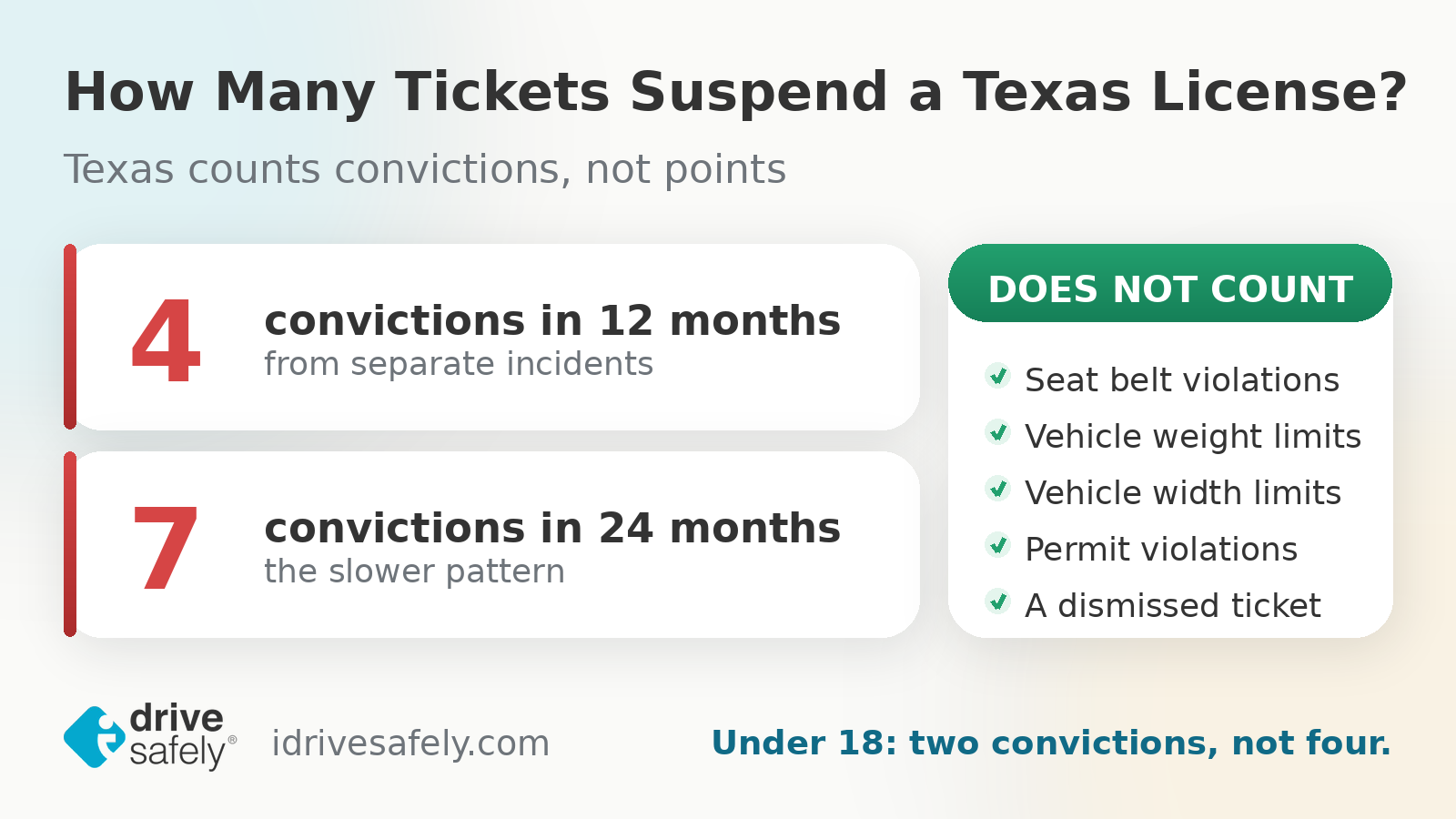
- Four or more moving violation convictions in 12 consecutive months, or seven or more in 24 months, makes a driver a habitual violator subject to suspension.
- The count is convictions from separate incidents, not tickets you received, so a ticket you keep from becoming a conviction never enters the math.
- Drivers under 18 face a far lower bar: two or more moving violation convictions in 12 months can trigger suspension.
Search this question, and most of what you find talks about points. That advice does not apply here. Texas ran a points system under the Driver Responsibility Program, and the legislature abolished it through House Bill 2048, effective September 1, 2019. Nothing accumulates on a Texas record the way points accumulate in other states. Instead, the state counts convictions, and the thresholds are specific.
Why Counting Points Gets You the Wrong Answer
There Is Nothing Left to Count
The surcharge program that assigned points to Texas drivers no longer exists. Any page telling you how many points a Texas speeding ticket adds, or how to remove points from a Texas record, is describing a framework the state retired. There is no point balance to check and no point total to reduce.
What Replaced It
Suspension authority now runs through the habitual violator provisions in the Transportation Code. Instead of a running score, the state looks at how many moving-violation convictions land on your record within a defined window. Cross the line, and the Department of Public Safety can act; stay under it, and the count resets as older convictions age out of the window.
The Two Conviction Thresholds
Four in Twelve Months
Under Texas Transportation Code 521.292(b), a driver is a habitual violator with four or more convictions arising out of different transactions within 12 consecutive months. "Different transactions" matters: three violations written during a single traffic stop are one transaction, not three entries toward the total.
Seven in Twenty-Four Months
The second threshold catches the slower pattern. Seven or more convictions from different transactions in 24 consecutive months meet the same definition, even if no single 12-month stretch reached four. You can read the provision itself through the Texas Transportation Code.
Out-of-State Convictions Count Too
Texas participates in the Driver License Compact, so a moving violation conviction from another state or a Canadian province can post to a Texas record and count toward these thresholds. A weekend speeding ticket three states away is not a separate problem from your Texas record.
How Long the Suspension Runs
The Automatic Ninety Days
When the Department of Public Safety sends notice of a habitual violator suspension and the driver does not request a hearing, the enforcement schedule sets an automatic 90-day suspension. Doing nothing is itself a choice, and it is the one that produces the default outcome.
What a Hearing Changes
Request a hearing and the case goes before a judge. An affirmative finding allows a suspension of up to one year, which is longer than the automatic period, so a hearing is a real decision rather than a free option. It also creates the opportunity to contest whether the convictions actually meet the statutory definition. The enforcement detail lives in the Texas Department of Public Safety materials.
Administrative and Separate From Your Court Case
This is the part that catches people. The suspension is an administrative action against your driving privilege, entirely separate from the criminal or municipal case on each individual ticket. You can walk out of municipal court having paid every fine, considering the matter closed, and still receive a suspension notice weeks later because those payments were convictions.
Which Violations Do Not Count
The Statutory Exclusions
Not every citation feeds the total. The statute excludes vehicle weight and width violations under sections 621.101, 621.201, and 621.203 through 621.207, along with permit violations under Chapter 623. Seat belt violations under section 545.413 are also excluded.
Why the Exclusions Matter
If you are counting your own convictions to see where you stand, leaving these out can be the difference between three and four. Anything genuinely non-moving, like a parking citation, was never in the count to begin with.
The Stricter Rule for Drivers Under 18
Two Convictions, Not Four
Section 521.292(a)(8) sets a separate trigger for minors. A driver under 18 convicted of two or more moving violations in a 12 month period is subject to suspension. That is half the adult exposure, reached in a single unlucky season of driving.
What This Means for Teen Drivers
A provisional driver who picks up one citation is already halfway to the threshold, which changes how seriously that first ticket should be treated. Our guide to teen driving restrictions covers the rules that produce most of those first citations.
How Dismissal Keeps a Ticket Off the Count
Conviction Is the Trigger, Not the Citation
Because the threshold counts convictions, the moment that matters is not when the officer hands you the ticket. It is what happens in court afterward. A ticket dismissed through a driver safety course never becomes a conviction, so it never enters the 12 month or 24 month window. To be precise about the mechanism: nothing is being removed from a point total, because there is no point total. The conviction simply never posts.
Whether Your Ticket Qualifies
Eligibility runs through the court, and not every citation qualifies. Our breakdown of which tickets qualify walks through the common disqualifiers, and the dismissal process covers what to file and when. The course itself is the Texas defensive driving course, taken online at your own pace once the court approves your request.
The Trap of Clearing Old Tickets All at Once
Here is a mistake worth avoiding. Drivers who let several citations sit unresolved sometimes decide to clean everything up in one trip and pay them all off together. Each payment is a conviction, and the convictions post with their own dates. Settling four old tickets can create four convictions clustered inside one 12 month window and manufacture a habitual violator finding out of tickets that were individually minor. If you have several outstanding, look at the dates before you pay anything.
Driving on a Suspended License
A Separate and Worse Problem
Driving while your license is suspended is its own offense, and it compounds rather than delays the original problem. Our guide to driving while suspended covers what the charge involves.
The Occupational License Option
Texas allows an occupational license for habitual violator suspensions. It is a restricted privilege granted by court order, typically limited to essential needs such as getting to work, to school, and to necessary household activities, with the court setting the hours and terms. It is not a reinstated license, but it keeps a suspension from costing you your job.
Frequently Asked Questions
How many speeding tickets before your license is suspended in Texas?
Four moving violation convictions from separate incidents in 12 consecutive months, or seven in 24 months, makes an adult driver a habitual violator subject to suspension. Speeding tickets count only once they become convictions, so a ticket dismissed through a driver safety course does not add to the total.
Does Texas still have a points system?
No, Texas abolished its points system and the Driver Responsibility Program effective September 1, 2019 under House Bill 2048. There are no points to accumulate or remove on a Texas driving record, and suspension is based on conviction counts instead.
Can you get a suspension lifted early in Texas?
The suspension period itself runs its course, but drivers facing a habitual violator suspension can request a hearing before it takes effect, and can petition a court for an occupational license that allows limited driving for work, school, and essential household needs during the suspension.
Ask the court about a course before you pay. It is the move most drivers miss.