


How Many Points Suspend a Florida License?
The cheapest suspension is the one that never starts.
Quick answers
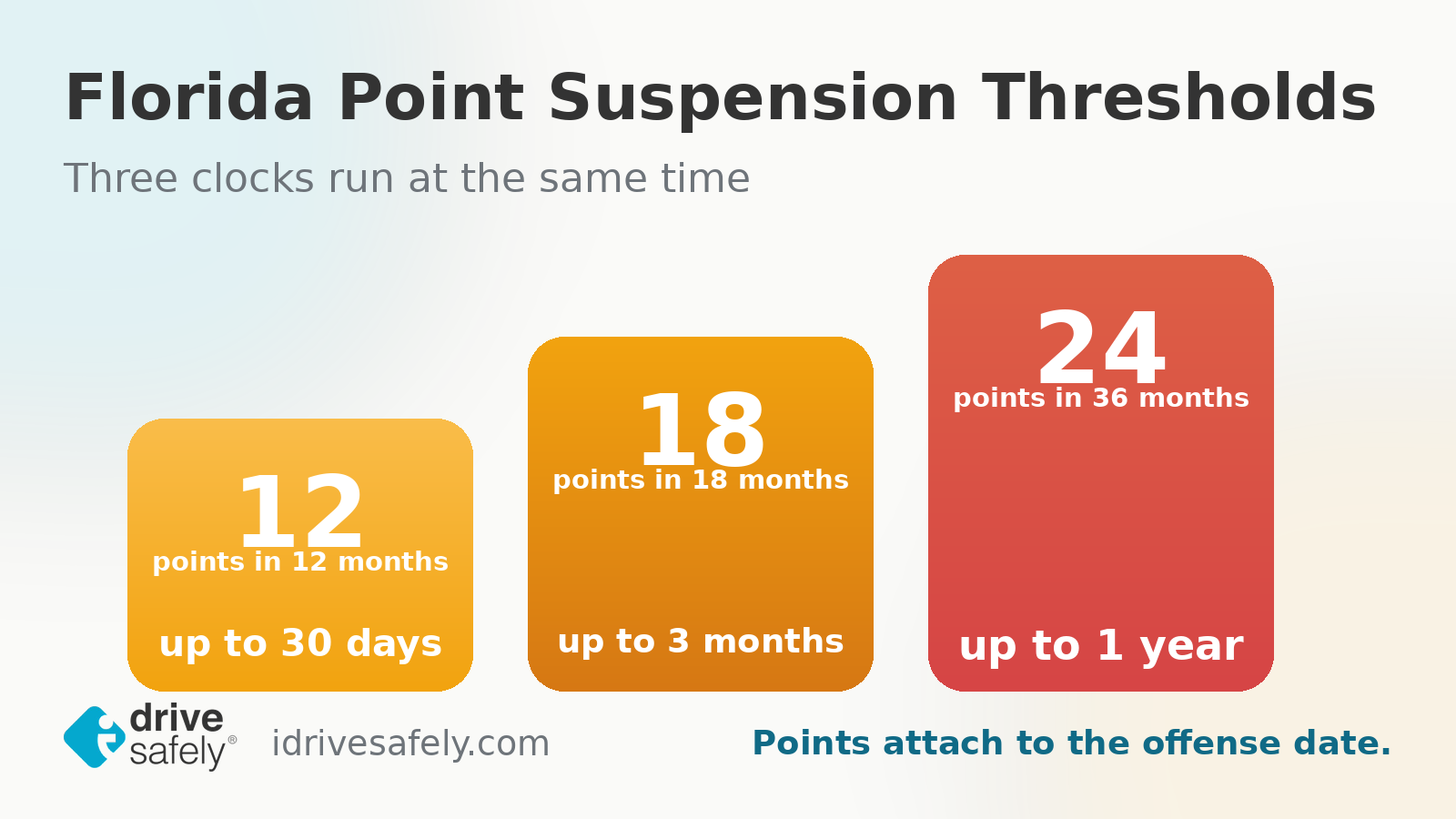
- 12 points in a 12-month period brings a suspension of not more than 30 days.
- 18 points in an 18-month period brings a suspension of not more than 3 months, and 24 points in a 36-month period brings a suspension of not more than 1 year.
- Points attach to the date you committed the offense, not the date of conviction, which is what makes the three clocks overlap.
Florida assigns points to moving violation convictions, and three separate thresholds can each trigger a suspension. Knowing where the lines are is the difference between managing a second ticket carefully and learning about the limit from a notice in the mail.
How Points Land on Your Record
Conviction, Then Points
Points post when a moving violation results in a conviction. The citation alone does nothing; it is the disposition that matters. That is why the decision you make with the clerk of court affects your record more than the traffic stop itself.
The Graduated Scale
Different violations carry different weight. Willful and wanton reckless driving carries 4 points. Leaving the scene of a crash with property damage over the statutory threshold carries 6. Unlawful speed or unlawful wireless device use that results in a crash carries 6. A moving violation committed with unlawful wireless device use in a school safety zone adds 2 points on top of the underlying violation, so a single incident can post more than one line.
The Three Suspension Thresholds
Twelve Points in Twelve Months
The first threshold under Florida Statute 322.27(5) is 12 points accumulated in a 12-month period, which allows a suspension of not more than 30 days.
Eighteen Points in Eighteen Months
The second is 18 points in an 18-month period, allowing a suspension of not more than 3 months. Note the wording, because it matters: the statute says not more than 3 months, while a great many sources describe this tier as a flat 90 days. The statutory language sets a ceiling, not a fixed term.
Twenty-Four Points in Thirty-Six Months
The third is 24 points in a 36-month period, allowing a suspension of not more than 1 year. You can read all three tiers through the Florida Statutes.
How the Three Clocks Overlap
Points Already Acted On Still Count
The 18-month and 36-month thresholds include points already acted upon. A driver who served a 30-day suspension at 12 points does not start over at zero. Those 12 points remain in the count for the longer windows, which means the next violation can trigger the second threshold quickly.
The Offense Date Governs
Points attach to the date of the offense rather than the date of conviction. A citation that takes months to resolve in court still posts its points back to the day it was written. Drivers tracking their own totals frequently misjudge this and assume a slow case bought them time in the window.
Three Windows Running at Once
All three periods run simultaneously and independently. You can sit comfortably below the 12 month threshold while the 36 month window quietly fills. Checking only the most recent year gives a falsely reassuring picture.
How Traffic School Keeps Points Off
Prevention Rather Than Removal
The most useful thing to understand about points in Florida is that the practical lever operates before they post, not after. When you elect a driver improvement course through the clerk of court and complete it, adjudication is withheld and no points are assessed for that violation. The points never attach in the first place.
The Limits on That Option
The election is capped at once every twelve months and eight times in a lifetime, so it is a finite resource rather than a repeatable fix. Our guide on how many times you can elect covers the counting rules. The Florida traffic school courses are online, self paced, and authorized by the State of Florida.
Which Violations Tend to Show Up
Most point accumulation comes from a small set of common citations rather than dramatic incidents. Our rundown of the most common violations covers what actually posts to Florida records.
What to Do When a Suspension Notice Arrives
Confirm the Underlying Record
Start by checking what has actually posted, because the notice reflects convictions the state has recorded, and those are occasionally not what a driver expects. Our guide on checking your points covers how to review your record before responding.
Driving Needs During the Suspension
Florida provides a hardship license path for drivers who need limited driving privileges during a suspension, typically for work and essential travel, and it carries its own application requirements. Our guide to hardship licenses walks through the process.
Do Not Drive on the Suspension
Driving during a suspension is a separate offense that adds a new problem rather than postponing the original one. Whatever the inconvenience, waiting it out or pursuing the hardship route is the shorter path back.
Frequently Asked Questions
How long does a Florida point suspension last?
It depends on which threshold you crossed: not more than 30 days at 12 points in 12 months, not more than 3 months at 18 points in 18 months, and not more than 1 year at 24 points in 36 months. The statute sets each as a maximum rather than a fixed term.
How long do points stay on a Florida license?
Points count toward the suspension thresholds for the length of each window, meaning 12, 18, or 36 months from the offense date depending on which threshold is being measured. The conviction itself remains on your driving record considerably longer than the points remain countable.
Can you remove points from a Florida license?
Points cannot be removed once they post. The available lever is electing a driver improvement course through the clerk of court before the violation is adjudicated, which withholds adjudication so no points are assessed for that citation at all.
Points can't come off once they post. Electing the course beforehand is what keeps them from posting at all. →