


How to Get Points Off Your North Carolina Driver's License

Your County Already Picked Your Course.
Guilford or Wake gets the 4-hour, everywhere else gets the 8-hour. Both run fully online, both save your spot when life interrupts.
Quick answers:
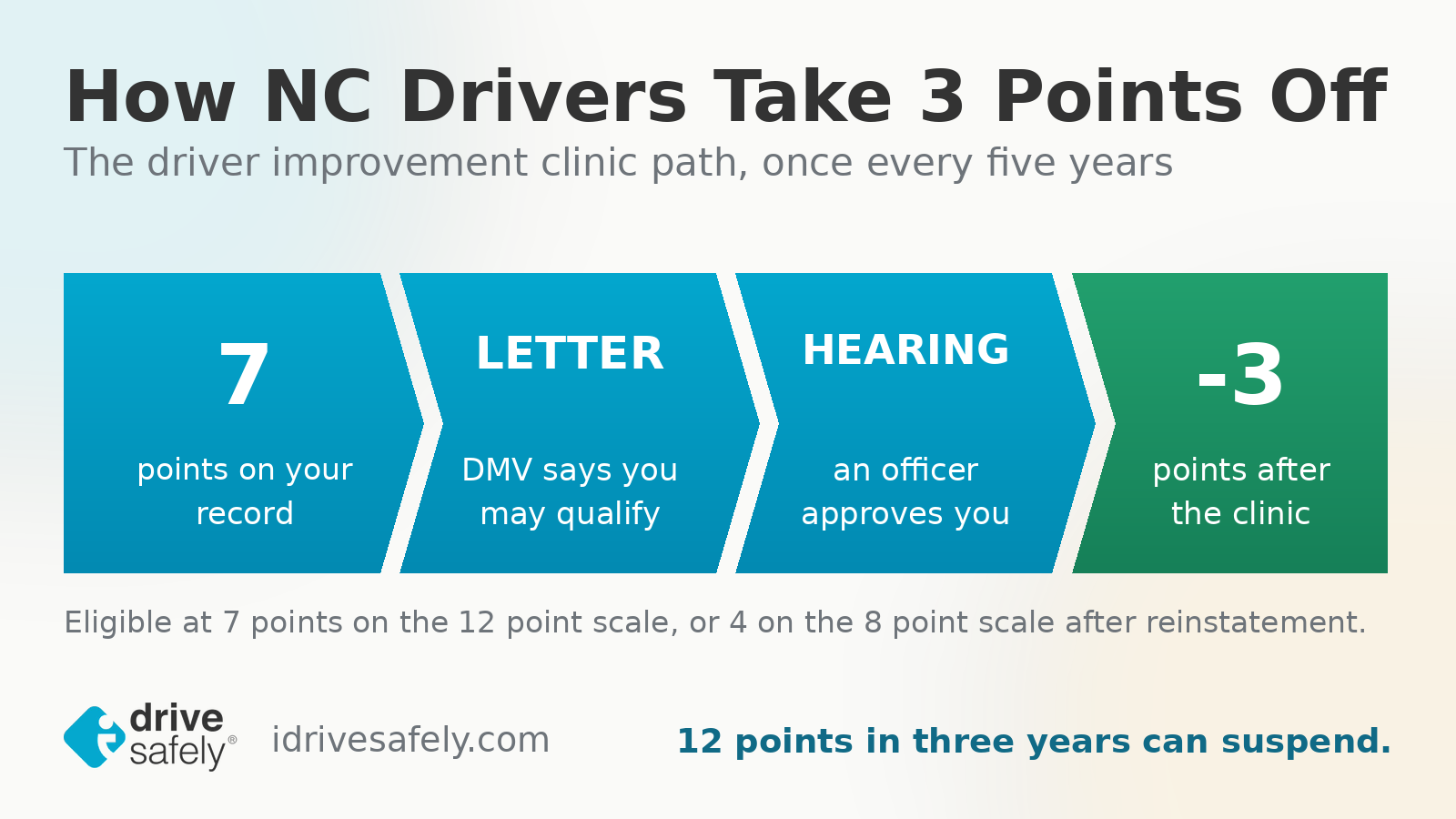
- North Carolina deducts three points after you complete a driver improvement clinic, available once every five years to drivers approved at a DMV eligibility hearing.
- You become eligible to request the clinic at seven points on the standard 12 point scale, or four points if you are on the eight point scale after a reinstatement.
- Points count toward suspension for three years, and 12 points in that window can suspend your license.
North Carolina gives drivers a real path to pull points back off a record, plus a few options that keep points from landing in the first place. The confusing part is that the state runs two separate point systems, and the course that helps depends on which one you are trying to protect.
How North Carolina License Points Work
Points Attach to the Offense Date
When you are convicted of a moving violation, the North Carolina Division of Motor Vehicles assigns points to your record as of the date you committed the offense, following a schedule set by statute. Paying a ticket counts as a conviction, which is why the decision you make before paying matters so much.
The Two Scales
Most drivers are on the 12 point scale. Drivers whose license was reinstated after a suspension move to an eight point scale for the three years that follow, with a much lower threshold for a second suspension.
NC Points Chart by Violation
The Heaviest Violations
Under the schedule in G.S. 20-16, the most serious common violations carry these values:
- Passing a stopped school bus: 5 points
- Aggressive driving: 5 points
- Reckless driving: 4 points
- Following too closely: 4 points
- Illegal passing or driving on the wrong side of the road: 4 points
- Hit and run with property damage only: 4 points
The Everyday Violations
- Speeding over 55 mph: 3 points
- Speeding in a school zone: 3 points
- Running a stop sign: 3 points
- Failure to properly restrain a child: 2 points
- All other moving violations: 2 points
How Long Points Stay on Your NC Record
The Three Year Window
For suspension purposes, North Carolina looks at points accumulated over three years. Once a violation is older than that window, its points stop counting toward a suspension, although the conviction itself stays on your driving history.
When Suspension Kicks In
Reaching 12 points within three years can suspend your license. After a reinstatement, 8 points within the following three years can trigger a second suspension. Knowing where you stand before the next ticket is the simplest protection there is.
Ways to Reduce or Avoid Points
The Driver Improvement Clinic
This is the one true point reduction path. According to the NCDMV clinic rules, drivers may request a clinic at seven points on the 12 point scale or four points on the eight point scale. The DMV mails a letter to drivers who may qualify, you apply for an eligibility hearing, and a hearings officer decides whether you are approved. Complete the clinic and three points come off your record. You can do this once every five years.
Asking the Hearings Officer About Online
If you would rather complete an online course than the in person clinic, raise it at your hearing. The hearings officer decides what satisfies the requirement, so get that answer before you enroll anywhere.
Keeping Points Off in the First Place
Before a conviction posts, some courts allow drivers to complete a traffic safety course in connection with a minor ticket. Whether that is offered, and what it does to the outcome, is up to the court handling your case. Call the clerk before your court date and ask.
How a Defensive Driving Course Fits In
Which Course Your County Uses
Courts in Guilford and Wake counties generally use a four-hour course, while the rest of the state generally uses eight hours. I Drive Safely offers both: the 8 hour course and the 4 hour course. Our guide to the course length difference covers when each applies.
What the Course Can Do for You
Drivers take the course because a court ordered it, because a hearing officer approved it for point credit, or voluntarily to ask their insurer about a discount. Each of those outcomes is decided by the court, the DMV, or your carrier, so confirm the benefit with the right party before you start. The enrollment steps walk through the process.
Insurance Points Versus DMV Points
Two Separate Systems
This is where most confusion comes from. DMV points decide whether your license is at risk. Insurance points are assigned separately by insurers under the state's Safe Driver Incentive Plan, and they decide what you pay. A single ticket can add points in both systems, and clearing one does not clear the other.
Why Insurance Points Often Cost More
A driver can sit comfortably below any suspension threshold and still watch premiums climb for years because of insurance points. That is why keeping a conviction off your record in the first place, when the court allows it, usually matters more than managing the DMV total afterward. Our breakdown of tickets and insurance shows how the costs add up.
Frequently Asked Questions
How do you get points off your license in North Carolina?
Complete a driver improvement clinic after approval at an NCDMV eligibility hearing, which deducts three points from your record. You can request the clinic at seven points on the 12 point scale, and the benefit is available once every five years.
How long do points stay on your license in NC?
Points count toward a North Carolina suspension for three years. After that window they stop counting, although the conviction remains on your driving history and can still affect insurance.
Do insurance points and DMV points work the same way in NC?
No, they are separate systems. DMV points determine whether your license can be suspended, while insurance points are assigned by insurers under the Safe Driver Incentive Plan and affect your premium.
Three points off is a real reset, and the course is the part you control. →
Looking for more driving resources?
Enter your email for deals, study materials, car maintenance tips, insurance savings, and more.