


Texas Teen Driving Restrictions and Curfew

The habits that make a confident Texas driver start with the course.
Quick answers:
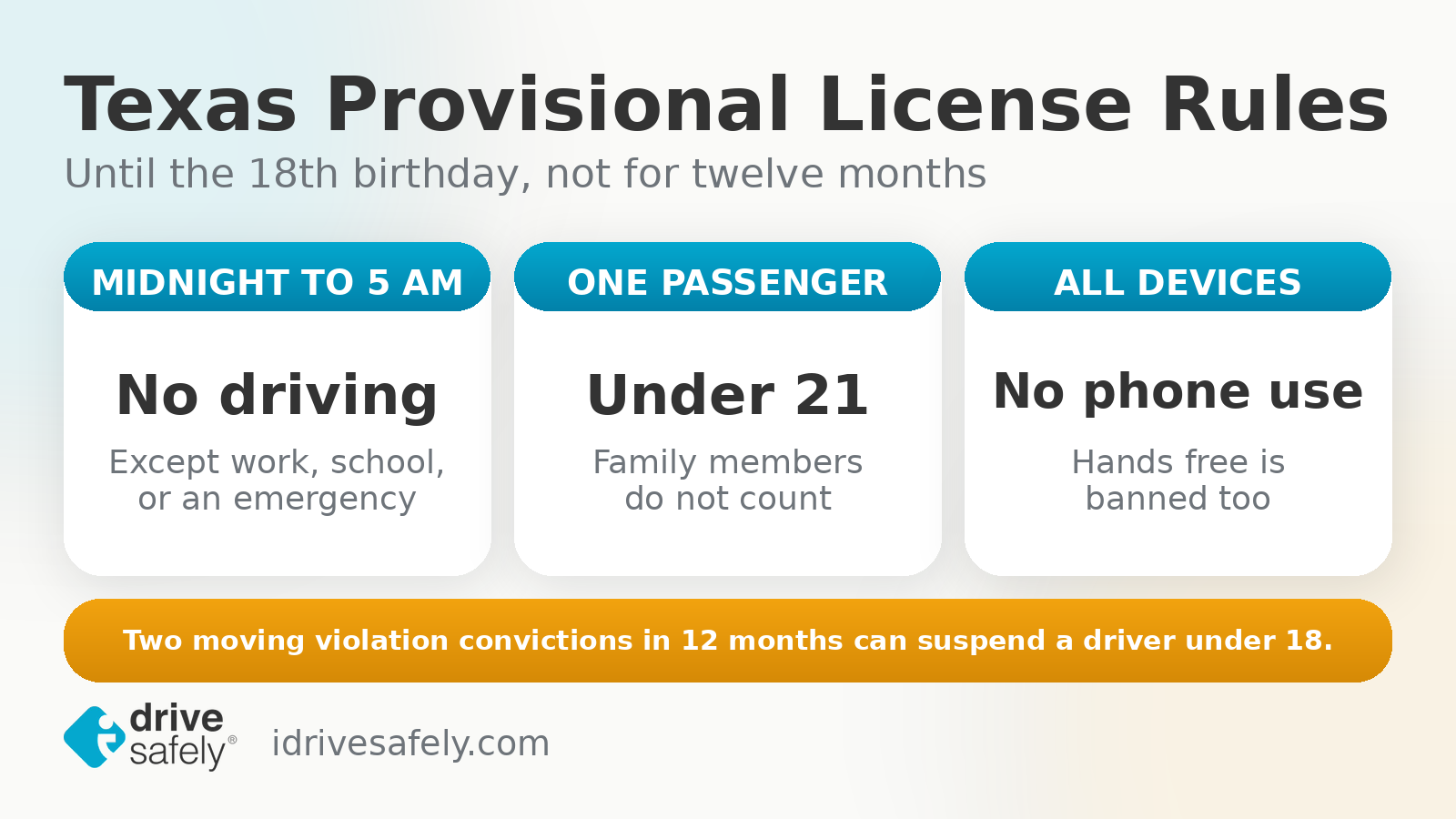
- Provisional drivers under 18 cannot drive between midnight and 5:00 a.m. except for work, school, or a medical emergency.
- They cannot carry more than one passenger under 21 who is not a family member, and cannot use any wireless communication device while driving, hands free included.
- These restrictions end at the driver's 18th birthday, not after a fixed twelve month term.
Getting the license is the part everyone plans for. What follows it is the part that surprises families, because a Texas provisional license comes with rules that look nothing like adult driving privileges, and a violation threshold set at half the adult level.
Phase One: The Learner License
Who Has to Be in the Car
A learner license holder can only drive with a licensed driver 21 or older seated in the front passenger seat, awake and able to take control. No version of this phase allows solo driving.
How Long This Phase Lasts
The learner license must be held for a minimum period before the teen can move to the next phase, and the supervised practice hours accumulate during this stretch. Families working through this phase can find the practice structure in our guide on teaching your teen, and the course packet process in our PTDE packet guide.
Phase Two: The Provisional License
What Changes
At this stage, the teen can drive alone. That is the significant change, and it is why families sometimes treat the provisional license as the finish line. It is not. Three restrictions apply, and they stay in place until the teen turns 18.
Why the Rules Exist
The restrictions target the three conditions most associated with crashes involving new drivers: driving late at night, driving with a carful of other teenagers, and driving distracted. Each rule below maps to one of those.
The Midnight Curfew
The Hours
Provisional drivers under 18 may not operate a vehicle between midnight and 5:00 a.m. Those are the hours themselves, not a guideline, and they apply every night of the week.
The Three Exceptions
Driving during those hours is allowed when the teen is going to or from work, going to or from a school-sanctioned activity, or responding to a medical emergency. The exceptions are narrow by design. A ride home from a friend's house at 12:30 a.m. is not covered, and neither is a late run for food after an event that has already ended.
The Passenger Rule
One Passenger Under Twenty One
A provisional driver may not carry more than one passenger under the age of 21. Two friends in the car is a violation, regardless of how short the drive is or whether everyone is buckled.
Who Counts as Family
Family members are excluded from the limit, which means a teen can drive siblings without running afoul of the rule. The exclusion covers family, not friends who feel like family, and not a friend's sibling.
The Wireless Device Ban Is Broader Than People Think
All Devices, Including Hands-Free
This is the rule most commonly described incorrectly. Plenty of sources tell Texas families the restriction covers handheld phones. The Department of Public Safety states that provisional drivers under 18 may not use any wireless communication device while driving, including hands-free systems. A Bluetooth call through the car stereo is a violation for a provisional driver even though it is legal for the adult in the next lane.
What That Rules Out
Voice calls, texting, and navigation handled through a phone all fall under the ban for provisional drivers. The practical advice is simple: the phone goes in the glove box before the car moves. You can confirm the current restrictions through the Texas graduated driver license program.
What Happens When a Teen Gets Ticketed
Two Convictions, Not Four
Adults become subject to suspension after four moving violation convictions in 12 months. For drivers under 18, Texas Transportation Code 521.292(a)(8) sets the threshold at two or more moving violation convictions in a 12-month period. Half the room for error, and most families don't realize the number is that low.
Why the First Ticket Is the One That Matters
At a two-conviction threshold, a single citation puts a teen one incident away from suspension. That reframes the first ticket from an expensive inconvenience into a genuine decision point about whether to pursue dismissal. Our guide to suspension thresholds covers how convictions are counted and what keeps a citation from becoming one.
A Restriction Violation Is a Moving Violation
Curfew, passenger, and device violations are themselves citable offenses. A teen can reach the two-conviction threshold without ever speeding, simply by being cited twice for having too many friends in the car.
What the Program Does Not Cover
Motorcycle Licenses
The graduated driver license program does not apply to motorcycle licenses, which run through a separate track with their own requirements.
Local Rules Still Apply
State restrictions are the floor, not the ceiling. School parking policies and municipal ordinances can add their own limits on top of what the state requires.
When the Restrictions End
The Eighteenth Birthday
This is worth stating plainly because it is frequently misunderstood: the provisional restrictions run until the driver turns 18. They are not a twelve-month term that expires once the teen has held the license for a year. A driver licensed at 16 carries them for roughly two years; a driver licensed at 17 and a half carries them for six months.
Setting Expectations at Home
Because the end date is an age rather than a countdown, families benefit from writing the rules down at the start. A parent teen driving agreement turns the state's restrictions into a shared household document rather than something a teen only hears about after a traffic stop. The habits start earlier than that, in the Texas teen drivers ed course itself.
Frequently Asked Questions
What time can a 16-year-old drive in Texas?
A 16-year-old with a provisional license can drive at any time except between midnight and 5:00 a.m., and during those hours only for work, a school-sanctioned activity, or a medical emergency.
Can a teen with a Texas provisional license use a phone hands free?
No, Texas prohibits provisional drivers under 18 from using any wireless communication device while driving, including hands-free systems. The restriction is broader than the handheld rules that apply to adult drivers.
How many passengers can a Texas provisional driver have?
No more than one passenger under the age of 21 who is not a family member. Family members do not count toward the limit, so a provisional driver can carry siblings freely.
Two years of provisional driving go smoothly when they start prepared.