


The Florida 50 Hour Driving Log: A Practice Guide for Teens and Parents

You will both feel ready.
The 50 hours of supervised driving are easier when your teen comes in prepared. The DETS course gives them the knowledge base, so your time in the passenger seat can focus on real-world skills.
Quick answers: Florida teens need 50 supervised driving hours, including 10 at night, with a licensed adult 21 or older in the front seat. The learner license must be held for 12 months without a moving violation before applying for a restricted license. A parent or guardian signs to certify the hours were completed.
What Florida Actually Requires
Before getting into how to use the hours, here is what the state asks for in plain language.
- Total hours: 50 hours of supervised driving with a licensed adult age 21 or older in the front passenger seat.
- Night hours: At least 10 of those 50 must take place at night.
- Permit holding period: The learner license must be held for 12 months without a moving violation, or until the teen turns 18, whichever comes first.
- Certification: A parent, legal guardian, or responsible adult age 21 or older must sign the Certification of Driving Experience of a Minor confirming the hours were completed.
The state provides a free driving log you can print and keep in the glove box. Logging hours as they happen is far easier than trying to reconstruct them at month 11.
Why the 50 Hours Matter More Than the Permit Test
Passing the Class E Knowledge Exam means a teen can recite that a solid yellow line means no passing. The 50 hours of practice are what teach a teen to actually decide, in real time, whether passing is safe even when the law allows it. Those are two different skills.
Research consistently shows that teens whose parents stay actively engaged during the supervised driving period crash less, drive impaired less, and wear seat belts more often than teens whose parents check out once the permit is in hand. The hours work, but only if they are real hours doing varied things, not 50 trips to the same grocery store.
How to Budget 50 Hours Across 12 Months

Fifty hours sounds like a lot until you spread it out. Across a full year, that is just under one hour per week. Most families find it easier to think in chunks rather than weekly minimums.
A realistic approach builds skill in four roughly equal phases. The first three months are foundational: empty parking lots, residential streets, low speed maneuvers, and mirror habits. Aim for about 15 hours during this stretch. Months four through six expand the comfort zone to multi lane roads, left turns across traffic, basic highway entries, and light rain. Another 15 hours fits well here.
Months seven through nine are where real world driving takes over. This is the time for sustained highway stretches, the required night hours, heavier traffic, and varied weather. Twelve hours during this phase gives the teen meaningful exposure to the conditions they will eventually face alone. The final three months, months 10 through 12, should focus on independence. The teen drives, the parent stays quiet unless safety requires speaking up, and the routes get unfamiliar on purpose. Eight hours of this kind of practice is more valuable than any other phase.
This pacing is a suggested framework, not a state mandate. A teen who logs 50 hours of identical neighborhood loops is technically compliant and still underprepared.
The Practice Curriculum: What Every Teen Should Cover
Florida's driving environment is unique. Hurricane season, sudden afternoon storms, retirees driving slowly in left lanes, tourist traffic near theme parks and beaches, and some of the longest causeway bridges in the country. The 50 hours should expose a new driver to as much of this variety as possible.
Core skills to log at least twice each
- Parallel parking on a real street with parked cars on both sides
- Backing into a parking space, not just pulling through
- Four way stops with multiple cars arriving at the same time
- Unprotected left turns across two or more lanes of oncoming traffic
- Merging onto a highway from a short on ramp
- Exiting a highway onto a curved off ramp at the posted advisory speed
- Roundabouts with two or more lanes
- Construction zones with lane shifts and reduced speed limits
- School zones during pickup and dropoff hours
- Driving in moderate rain with wipers and reduced visibility
Florida specific situations to practice deliberately
- Long bridges and causeways with crosswinds, such as the Howard Frankland, Sunshine Skyway approach roads, or Seven Mile Bridge if you are in the Keys
- Tourist heavy areas with frequent pedestrian crossings and slow moving traffic
- Toll plaza navigation, including SunPass lanes versus cash lanes
- Sudden afternoon thunderstorms, the kind that go from sunny to zero visibility in five minutes
- Driving near loaded pickup trucks and trailers on rural two lane highways
- Navigating a hurricane evacuation route during off peak conditions, so the route is familiar before it ever needs to be used in earnest
Drivers ed is a team sport.
The DETS course gets your teen up to speed on Florida traffic laws in six self-paced online hours
The 10 Night Hours Are the Most Important
Florida teens are statistically more likely to crash at night than during the day, and the gap widens after a teen receives the restricted license at 16 or 17. The 10 night hours required by the state are a floor, not a ceiling. Aim for 15 if your schedule allows it.
Night driving introduces variables that daytime practice cannot replicate.
- Headlight glare from oncoming traffic, especially on undivided roads
- Difficulty judging the speed of approaching vehicles
- Pedestrians and cyclists wearing dark clothing
- Wildlife crossing rural roads, particularly deer in some regions
- Reduced ability to read street signs and house numbers
- Drivers who have been drinking, who are statistically more common after 10 p.m.
Start night driving at dusk rather than full darkness so the transition feels gradual. Log a mix of well lit suburban roads, dark rural stretches, and at least a few highway miles after sunset.
How Parents Can Coach Without Becoming Backseat Drivers
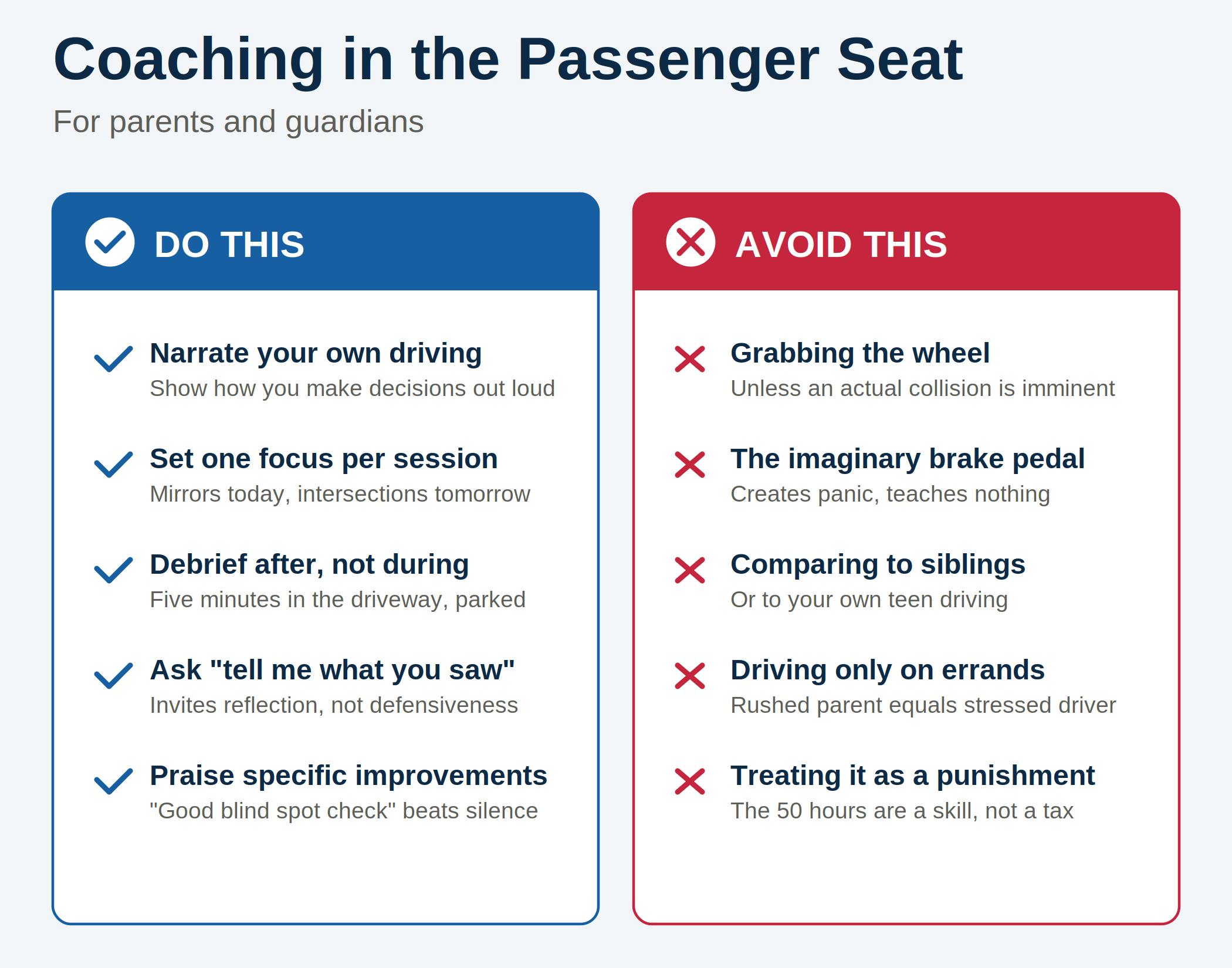
The hardest part of supervised driving is not the driving. It is the relationship in the front seat. A parent who yells every time the teen drifts within the lane creates a tense, fearful driver. A parent who scrolls through email and ignores everything creates an unsupervised driver.
Coaching habits that actually help
- Narrate your own driving for the first few sessions. Before the teen takes the wheel, drive a route yourself and explain the decisions out loud. This is called commentary driving and it shows the teen what an experienced driver is actually thinking about.
- Set one focus per session. Today is intersections. Today is mirror checks. Today is highway lane changes. A scattered session teaches less than a focused one.
- Save the debrief for after the car is parked. Critique in motion creates panic. A five minute conversation in the driveway afterward sticks better than mid drive corrections.
- Use the phrase "tell me what you saw" instead of "why did you do that." The first invites reflection. The second invites defensiveness.
- Recognize improvement out loud. New drivers are flooded with what they are doing wrong. Specific praise for what they are doing well is what builds confidence and consistency.
Habits to avoid
- Grabbing the wheel unless an actual collision is imminent
- Slamming an imaginary brake pedal on the passenger floor
- Comparing the teen's driving to a sibling's or your own at that age
- Letting the teen drive only when you are running errands and feel rushed
- Treating the 50 hours as a punishment to complete rather than a skill to build
Common Mistakes That Waste the 50 Hours
Driving only in one type of condition
Fifty hours of weekend daytime errands creates a driver who is confused the first time they encounter rush hour or rain. Variety is the entire point.
Skipping the log and reconstructing later
Memory is generous. Ten hours of practice can feel like 30 if you are guessing months later. A parent who signs the certification form without an honest log is signing something they cannot verify, and the teen loses the chance to see real progress over time.
Treating the permit test as the finish line
Passing the knowledge exam is the start of the 12 month permit phase, not the end. Some families relax practice after the permit is issued and then scramble in month 11. The opposite approach works better. Front load practice in the first six months while motivation is high.
Only practicing with one parent
If two licensed adults are available, alternate. Different drivers notice different things, give different feedback, and prepare the teen for the reality that other adults will eventually be passengers.
Ignoring the post permit course material
The required DETS course covers concepts that take real practice to internalize. Revisit the course material periodically during the 12 months, especially the sections on defensive driving, distracted driving, and stopping distances. The material lands differently after a teen has actually driven a few thousand miles.
What Happens When the 50 Hours Are Done
Once the teen has logged 50 hours, with at least 10 at night, and has held the permit for 12 months without a moving violation, they are eligible to apply for a restricted license. The parent or guardian signs the Certification of Driving Experience of a Minor and brings it to the appointment.
At the appointment, the teen will take the behind-the-wheel driving test if they did not complete it through an approved third-party administrator. They will also pass a vision and hearing check. With the restricted license in hand, new driving curfews apply.
- 16-year-old drivers: May only drive between 6 a.m. and 11 p.m. unless accompanied by a licensed adult 21 or older, or driving to or from work.
- 17-year-old drivers: May only drive between 5 a.m. and 1 a.m. under the same exceptions, meaning no driving between 1 a.m. and 5 a.m.
Frequently Asked Questions
Do the 50 hours need to be tracked on the official state form?
The state provides an official driving log, but any honest record works as long as the parent or guardian signs the Certification of Driving Experience of a Minor at the end. A notebook, a spreadsheet, or a phone app are all acceptable for personal tracking.
Can a sibling or older friend supervise some of the hours?
Yes, as long as the supervising driver is at least 21 years old, holds a valid license, and is in the front passenger seat. They do not need to be a parent or legal guardian. Only the certification form at the end requires a parent, legal guardian, or other responsible adult age 21 or older.
What counts as night driving for the 10 night hours?
Florida treats night driving as any time between sunset and sunrise. A 6 p.m. drive in December counts. A 6 p.m. drive in June does not. Check sunset times for the date you are driving if you want to be sure the hours qualify.
Can the 50 hours be completed faster than 12 months?
The hours can be completed in any timeframe within the 12-month permit period, but the permit must still be held for the full 12 months, or until age 18, before the teen can move to a restricted license. Logging all 50 hours in the first three months is allowed and arguably better, but it does not shorten the waiting period.
What happens if a teen gets a ticket during the 12-month permit phase?
A moving violation conviction can reset the 12-month clock or otherwise delay the teen's progression to a restricted license. This is why defensive driving habits during the practice period are not just academic.
The 50 Hours Are an Investment, Not a Tax
The temptation to treat supervised driving as a bureaucratic hurdle is real. The form gets signed either way. But the teens who use the year well are dramatically less likely to have a crash, a ticket, or a serious near miss in their first year of independent driving. Those outcomes show up in insurance premiums, in family stress, and most importantly in safety.
Print the log, schedule the practice, vary the conditions, and treat each hour as one more piece of preparation for the day the parent is no longer in the passenger seat. That day is closer than it feels.
Built for the pace of teen life.
Six self-paced online hours, finished on your teen's schedule.
Looking for more driving resources?
Enter your email for deals, study materials, car maintenance tips, insurance savings, and more.