


How To Get Your California Driver's License as a Teen
Five milestones, and the first one is a course you can start today.
Everything after it waits on this.
Quick Answer:
- California teens complete drivers ed, pass the permit test at 15 and a half or older, and start professional behind-the-wheel training, which activates the permit.
- You hold the permit at least 6 months, finish 6 hours of professional training, and log 50 practice hours including 10 at night.
- Yes, you can get a California license at 16: once those steps are done, you take the road test and receive a provisional license with night and passenger limits for the first 12 months.
Getting licensed in California is a sequence, not a scramble. Each step unlocks the next, and teens who know the order can plan the whole path from a first drivers ed lesson to a license close to their 16th birthday. Here is the complete route, in order.
The California Teen Licensing Path at a Glance
Five Steps in Order
- Complete a DMV-approved drivers ed course and receive your certificate
- Pass the permit test at 15 and a half or older
- Begin professional behind-the-wheel training to activate the permit
- Hold the permit 6 months while finishing training and 50 practice hours
- Pass the road test at 16 or older and drive with a provisional license
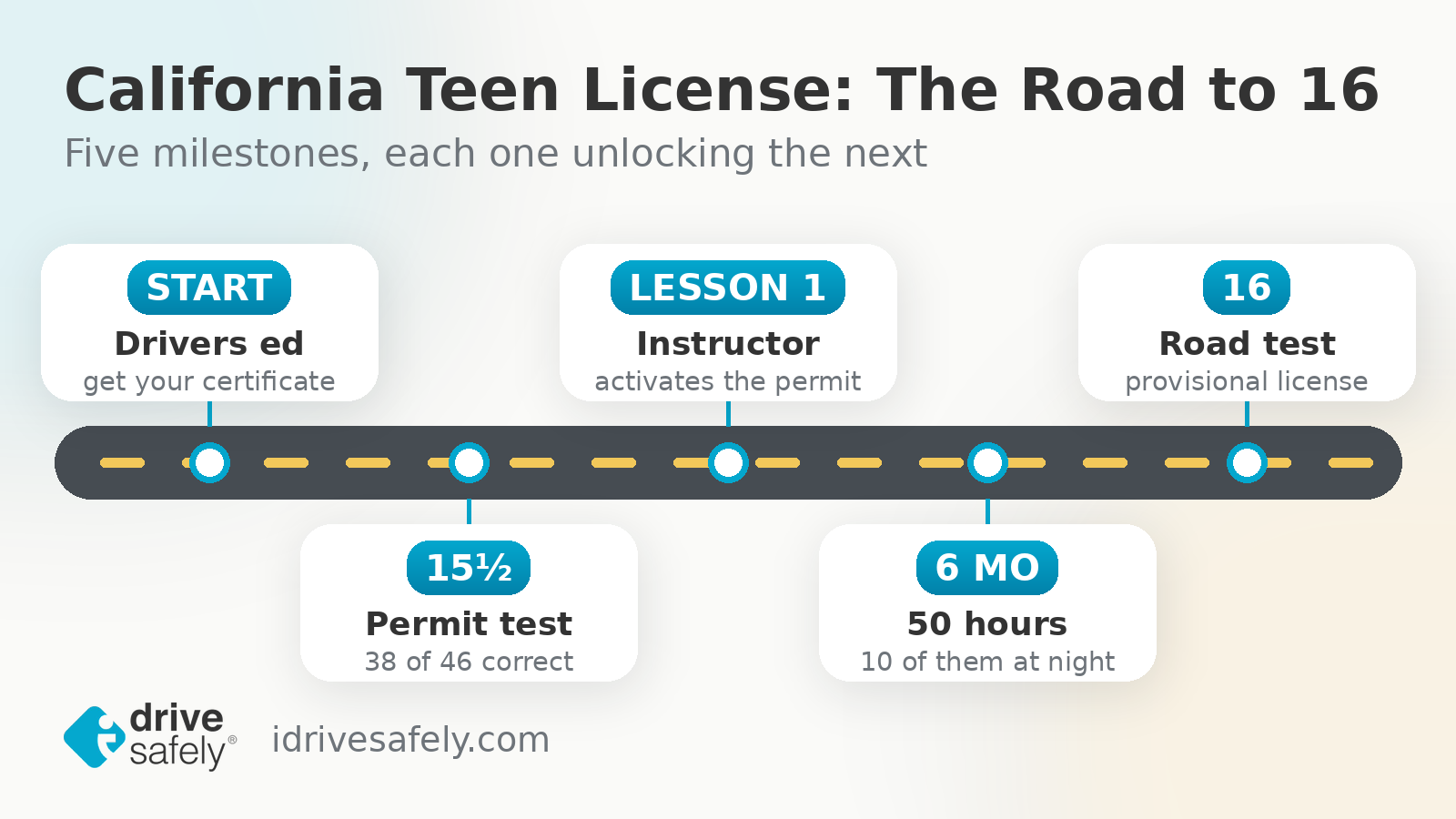
How Long the Whole Path Takes
The 6 month permit period sets the pace. A teen who gets a permit right at 15 and a half can reach the road test right around 16. Starting drivers ed a few months ahead of that date keeps everything on schedule.
Drivers Ed and What California Requires Before a Permit
The Course Requirement
Teens under 18 must complete a DMV-approved driver education course before applying for a learner's permit. The California drivers ed course from I Drive Safely is DMV approved, fully online, and self paced, with interactive lessons and practice questions that mirror the permit test. It covers traffic laws, road signs, right of way, and how alcohol and drugs affect judgment behind the wheel.
Online or Classroom
California accepts either format. Online courses let teens fit the work around school and activities instead of losing weekends to a classroom. Our guide to online or classroom drivers ed covers the tradeoffs.
The Certificate You Will Need
When you finish, you receive a certificate of completion. The DMV will not issue a permit without it, so keep it with your application paperwork.
Getting Your Learner's Permit
What to Bring
Bring your drivers ed certificate, proof of identity and residency, and an application signed by a parent or guardian to the California DMV. You also pass a vision screening. Our full permit guide covers the application in detail.
The Permit Test
Teens take a 46 question knowledge test and need at least 38 correct to pass. You get three attempts, with a 7 day wait after a failed try. These permit test tips help most teens pass on the first sitting.
Activating the Permit
Here is the step that surprises families: the permit is not valid for driving until you begin behind-the-wheel training with a licensed instructor, who signs it to activate it. Book that first lesson soon after the permit test so your 6 month clock starts.
Behind-the-Wheel Training and Practice Hours
Six Hours With a Professional
California requires 6 hours of professional behind-the-wheel training with a licensed instructor, commonly split into three lessons of two hours each. An instructor builds the scanning, mirror checks, and decision making that road test examiners look for.
Fifty Practice Hours
Between lessons, teens log at least 50 hours of supervised driving, including 10 hours at night, with a licensed driver age 25 or older. Mix in freeways, busy boulevards, parking lots, and rain when you can. A parent or guardian certifies those hours when you apply for the license.
The 6 Month Minimum
No matter how quickly the hours add up, the permit must be held at least 6 months before the road test.
Parents: The Newest Driver Can Be the Safest One.
Our California course builds the habits before the habits build themselves.
Your Provisional License and Its Restrictions
Taking the Road Test
Once you are 16, have held the permit 6 months, and have finished training and practice hours, you can schedule the driving test. Examiners watch turns, lane changes, stops, speed control, and how you handle traffic. These road test tips cover the habits that earn points.
The First 12 Months
Your first license is provisional. For the first 12 months, you may not drive between 11 p.m. and 5 a.m. or carry passengers under 20 unless a licensed driver 25 or older is with you. Limited exceptions cover school, work, medical needs, and immediate family needs, generally with a signed note. The restrictions end after 12 months or at 18, whichever comes first.
Setting Rules at Home
A written parent teen agreement turns the state rules into shared expectations before the first solo drive.
What It Costs and How Long It Takes
The Cost Pieces
Families budget for four things: the drivers ed course, professional behind-the-wheel training, the DMV application fee, and the added cost of insuring a new driver. The DMV application fee covers the permit, the knowledge test attempts, and the road test, so check the DMV fee schedule when you apply.
The Timeline
The fastest path runs about 6 months from permit to license, which puts the earliest license at 16. Most teens take a little longer because of road test appointment availability, so booking early is the simplest way to stay on track.
Frequently Asked Questions
Can you get a driver's license at 16 in California?
Yes. California teens can take the road test at 16 after completing drivers ed, holding a permit for 6 months, finishing 6 hours of professional behind-the-wheel training, and logging 50 practice hours. The first license is provisional, with night and passenger restrictions for 12 months.
How do you get a driver's permit in California?
Complete a DMV-approved drivers ed course, then visit the DMV at 15 and a half or older with your certificate, identity documents, and a parent signed application. Pass the vision screening and the 46 question knowledge test with at least 38 correct answers.
Is drivers ed required in California?
Yes, for anyone under 18 who wants a license. Teens must complete a DMV-approved driver education course before applying for a learner's permit, plus 6 hours of professional behind-the-wheel training before the road test.

How to Get a Class A License for Commercial Driving
In most states, a Class A license is needed to operate a vehicle with two or more axles. Learn more about how to get a Class A license.
How to Take a North Carolina Defensive Driving Course
Want to dismiss points from your record? Learn the steps you need to take and complete the North Carolina defensive driving course.
Looking for more driving resources?
Enter your email for deals, study materials, car maintenance tips, insurance savings, and more.